My strawberries started to die off.
I don't like it when that happens.
I have it on very good authority that strawberries wouldn't like being in a constant flood.
It turns out good authority is good.
They went brown, then wilty, then mouldy.
They're still alive, so I thought I might just add a bell siphon, and give them the intermittent dry feet they reputably enjoy so much.
I didn't really have anything to make a proper siphon out of, so I stuck a plastic cup over the existing standpipe, and it seems to be working perfectly.
I don't understand what it is about the humble bell siphon, but once you've made a few, they just always seem to work. I'm guessing that comes down to subconsciously picking the correct size tubing or something , although I have no idea what I'm doing.
I guess that's why they call it subconscious.
It might also be that I'm kidding myself as to my tube divining skills, and that really I've just been lucky.
Anyway, I thought I might do a bit of research and actually make some kind of chart with different flow rates and the required/suitable tubing diametres etc, I remember wondering where to start when I made my first bell siphon, and no matter how much stuff I read, I could never find the kind of info I needed.
But...
For the time being, here is my plastic cup.
I'll let you know when it fails.
120 Things in 20 years finds me asking myself, "Am I wrong to expect someone to have made a chart showing suitable tubing for a siphon build to suit a pump with a home made wire front bearing?".
It's my intention to gain a new ability every 2 months for the next 20 years. I'd enjoy some company, some help, and some constructive criticism.
Things so far...
Animation
(5)
Aquaponics
(340)
Bread
(15)
Cheese
(16)
Epic adventurer
(20)
Escargot
(2)
Fire
(6)
Fraudster
(1)
Handmade fishing lures
(31)
Home made preserves
(11)
Making smoked foods
(11)
Mold making
(7)
Movie watcher and critic
(2)
PVC
(36)
Photography
(17)
Snail farming
(6)
Solar hot water
(26)
Solar photovoltaic panels
(7)
Stirling Engines
(11)
Thinking
(52)
Vermiculture
(1)
Wind energy
(26)
cooking
(49)
electronics
(57)
Showing posts with label bell siphon. Show all posts
Aquaponics - Instant siphon extension
One of the issues with rising sea levels is that you cant just pile up extra dirt and hope all your plumbing will still work.
Mine didn't.
As a result of the extra few centimeters of scoria I added, I lifted all the existing plants except the tomatoes. As I understand it, the tomatoes will just send down some extra roots from the newly buried stem, and all it will do is make them grow with even more vigor.
The rest of the plants may well now have their roots too far out of the wet stuff for their liking, so I need to lengthen the stand pipe, and the siphon to accommodate it.
For the bacteria to take advantage of the extra media depth, it needs the water level to rise, so the solution was an instant siphon extension.
The standpipe was easy enough, as a standard length of black poly pipe fit in the existing standpipe.
And I found that one of my black plastic pots fit nicely inside the siphon, and they are tapered, so I could jam it in to make it stick.
All it took was to cut the bottom out.
Drill some holes around the bottom edge to let the water flow through freely.
And finally, I jammed the narrow end into the siphon.
Done.
It even look good(ish).
Today on 120 Things in 20 years, rising water levels demand an instant siphon extension to be added to my aquaponics system.
Mine didn't.
As a result of the extra few centimeters of scoria I added, I lifted all the existing plants except the tomatoes. As I understand it, the tomatoes will just send down some extra roots from the newly buried stem, and all it will do is make them grow with even more vigor.
The rest of the plants may well now have their roots too far out of the wet stuff for their liking, so I need to lengthen the stand pipe, and the siphon to accommodate it.
For the bacteria to take advantage of the extra media depth, it needs the water level to rise, so the solution was an instant siphon extension.
The standpipe was easy enough, as a standard length of black poly pipe fit in the existing standpipe.
And I found that one of my black plastic pots fit nicely inside the siphon, and they are tapered, so I could jam it in to make it stick.
All it took was to cut the bottom out.
Drill some holes around the bottom edge to let the water flow through freely.
And finally, I jammed the narrow end into the siphon.
Done.
It even look good(ish).
Today on 120 Things in 20 years, rising water levels demand an instant siphon extension to be added to my aquaponics system.
Aquaponics - Self cleaning swirl filter Mk 2
I think I have a better idea for a self cleaning swirl filter.
Water enters a bucket part way up from the bottom. My picture show half way up, but I think it would be better where the "*" is around a third of the way up. The water enters via an elbow to set up a whirl pool.
Solids gravitate towards the centre, and sink to the bottom.
The first dump back to the grow beds is a hole in the stand pipe down the bottom, that creates a constant, gentle, downwards flow to further encourage solids to drop out of suspension.
The second dump device, is a bell siphon that periodically dumps water, creating a powerful suction, cleaning the filter of collected solids and returning them to the grow bed. This siphon is shortened by a breather pipe that means it only changes the height of water from between the "high tide" and the "low tide" marks rather than dumping all the water. If all the water is dumped, you loose the gentle entry of the water, and the swirl is broken down each time the device is empty.
A third dump intermittently exists at the top of the filter to act as a leaf skimmer. This would only flow at the top of each fill cycle, and would just be a trickle for a few seconds as the container is at its fullest, and would dump any floating particulates back to the grow bed.
Finally, water exits from the filter from a point just under the low tide mark. This would be the water that flows through the NFT tubes as it would be almost free of heavy solids, and would also not collect any floating solids.
Floating solids are sometimes sucked into the pump when fish disrupt them from the surface, when they get caught into a whirl pool and sucked down into the pump, or when the grow bed empties onto them, pushing them under water. Duckweed is at a very fine balance between floating and sinking when it's getting old, and can stay under water for a minute or so before slowly rising back to the surface. A fish swimming by can easily pull some under water where it might find it's way to the filter. It doesn't happen often, but I find 3 or four leaves a day go through the pump if I put a sieve under the grow bed outlet to check what the pump is lifting up.
There you have it, a self cleaning swirl filter.
Perhaps.
I'll make one to check.
Water enters a bucket part way up from the bottom. My picture show half way up, but I think it would be better where the "*" is around a third of the way up. The water enters via an elbow to set up a whirl pool.
Solids gravitate towards the centre, and sink to the bottom.
The first dump back to the grow beds is a hole in the stand pipe down the bottom, that creates a constant, gentle, downwards flow to further encourage solids to drop out of suspension.
The second dump device, is a bell siphon that periodically dumps water, creating a powerful suction, cleaning the filter of collected solids and returning them to the grow bed. This siphon is shortened by a breather pipe that means it only changes the height of water from between the "high tide" and the "low tide" marks rather than dumping all the water. If all the water is dumped, you loose the gentle entry of the water, and the swirl is broken down each time the device is empty.
A third dump intermittently exists at the top of the filter to act as a leaf skimmer. This would only flow at the top of each fill cycle, and would just be a trickle for a few seconds as the container is at its fullest, and would dump any floating particulates back to the grow bed.
Finally, water exits from the filter from a point just under the low tide mark. This would be the water that flows through the NFT tubes as it would be almost free of heavy solids, and would also not collect any floating solids.
Floating solids are sometimes sucked into the pump when fish disrupt them from the surface, when they get caught into a whirl pool and sucked down into the pump, or when the grow bed empties onto them, pushing them under water. Duckweed is at a very fine balance between floating and sinking when it's getting old, and can stay under water for a minute or so before slowly rising back to the surface. A fish swimming by can easily pull some under water where it might find it's way to the filter. It doesn't happen often, but I find 3 or four leaves a day go through the pump if I put a sieve under the grow bed outlet to check what the pump is lifting up.
There you have it, a self cleaning swirl filter.
Perhaps.
I'll make one to check.
Aquaponics - Short siphon
A bell siphon usually dumps all the water from an aquaponics grow bed. It does this by creating a siphon once the water gets to a certain level.
The cool thing about it, is that once triggered, it lifts water up and over a standpipe, and does this until the grow bed has drained. This gives us our flood and drain cycle in our grow bed.
One alternative to using a bell siphon, is to run your crow bed as constant flood. To do this all we have to do is remove the bell, and leave the water to reach the level of the standpipe, and circulate.
It seems constant flood has some advantages.
A constant flood system holds more water, so might be a bit more stable. Whenever anything changes in a system, having more water means that it tends to change more slowly. There is also probably a bit more real estate for the micro beasties to live in.
Most plants don't seem to mind so it looks like a thing worth doing on at least some grow beds if you have more than one.
I only have one, and its very stable, but my fish are getting bigger, so there might come a time when I'm running my system a bit closer to its fish holding capacity. With this in mind I'd like to maximise my system's ability to deal with the extra load.
One possible problem with constant flood, is that over time it might be more likely for areas to become stagnant. Constant flood pulls water from the top. If you are adding water to the top and taking it from the top, the water might ignore your desire to move through the system, and just take a short cut straight from the inlet to the outlet.
A system using a bell siphon drains in a fairly dramatic fashion as all the water is dumped, often a lot faster than it went in. This sucks a lot of air down into the media, and also creates a powerful surge throughout the system. The strong surge might help to distribute solids away from the water inlets, spreading them more evenly through the grow bed. A siphon pulls water from the bottom, and this might also aid in distributing nutrient evenly.
Constant flood = good
Flood and drain = good.
I hate the way the universe can do that sometimes. Make up your mind universe.
In an effort to greedily get the best of both worlds, I have changed my siphon a bit.
The small tube on the outside is an air breather pipe. It's purpose is to aid the siphon to stop in a decisive manner. If your siphon doesn't match your pump flow, there can be a condition where, at the end of the cycle when your siphon should stop, it continues to trickle out water at the same rate that the pump is pumping in. (see this post on calibrating a new bell siphon)
This means you system can be stuck on empty.
Plants and bacteria hate that.
If your plants and bacteria aren't happy, your fish are miserable.
When the water level gets down to the breather pipe, it suddenly sucks air and stops the siphon. Basically it just makes the siphon a bit more forgiving.
What this means, is that we can mount that breather pipe further up the bell, and when the water empties to that level, the siphon stops.
So now we can have a situation where the only 20% of the grow bed is drained, but it is still drained with a powerful surge, and it also still drains from the bottom. This may well provide a decent compromise.
I have a feeling plants will enjoy having their feet always wet, but their knees in flood and drain.
I'll let you know if anything terrible happens.
The cool thing about it, is that once triggered, it lifts water up and over a standpipe, and does this until the grow bed has drained. This gives us our flood and drain cycle in our grow bed.
One alternative to using a bell siphon, is to run your crow bed as constant flood. To do this all we have to do is remove the bell, and leave the water to reach the level of the standpipe, and circulate.
It seems constant flood has some advantages.
A constant flood system holds more water, so might be a bit more stable. Whenever anything changes in a system, having more water means that it tends to change more slowly. There is also probably a bit more real estate for the micro beasties to live in.
Most plants don't seem to mind so it looks like a thing worth doing on at least some grow beds if you have more than one.
I only have one, and its very stable, but my fish are getting bigger, so there might come a time when I'm running my system a bit closer to its fish holding capacity. With this in mind I'd like to maximise my system's ability to deal with the extra load.
One possible problem with constant flood, is that over time it might be more likely for areas to become stagnant. Constant flood pulls water from the top. If you are adding water to the top and taking it from the top, the water might ignore your desire to move through the system, and just take a short cut straight from the inlet to the outlet.
A system using a bell siphon drains in a fairly dramatic fashion as all the water is dumped, often a lot faster than it went in. This sucks a lot of air down into the media, and also creates a powerful surge throughout the system. The strong surge might help to distribute solids away from the water inlets, spreading them more evenly through the grow bed. A siphon pulls water from the bottom, and this might also aid in distributing nutrient evenly.
Constant flood = good
Flood and drain = good.
I hate the way the universe can do that sometimes. Make up your mind universe.
In an effort to greedily get the best of both worlds, I have changed my siphon a bit.
The small tube on the outside is an air breather pipe. It's purpose is to aid the siphon to stop in a decisive manner. If your siphon doesn't match your pump flow, there can be a condition where, at the end of the cycle when your siphon should stop, it continues to trickle out water at the same rate that the pump is pumping in. (see this post on calibrating a new bell siphon)
This means you system can be stuck on empty.
Plants and bacteria hate that.
If your plants and bacteria aren't happy, your fish are miserable.
When the water level gets down to the breather pipe, it suddenly sucks air and stops the siphon. Basically it just makes the siphon a bit more forgiving.
What this means, is that we can mount that breather pipe further up the bell, and when the water empties to that level, the siphon stops.
So now we can have a situation where the only 20% of the grow bed is drained, but it is still drained with a powerful surge, and it also still drains from the bottom. This may well provide a decent compromise.
I have a feeling plants will enjoy having their feet always wet, but their knees in flood and drain.
I'll let you know if anything terrible happens.
Aquaponics - Cluster siphon success
I'm getting more and more confused by this idea of mine by the minute.
But anyway here's a simplified version of the Bullwinkle Siphon working at a range of different water flows. Possible advantages include not having to calibrate it, and perhaps using it in a solar or wind powered aquaponics system where there might be variable flow rates. Within reason it should start and stop without any trouble regardless of flow rate.
One of my better ideas.
Just to clarify, my idea is to have multiple standpipes in a bell siphon. As usual, as far as I know this is an original idea and blah blah blah. I give it freely to the world to make whatever use of as you see fit. Enjoy it, profit from it, hate it, etc etc etc.
By the way the mandarins are just there as packing to hold things in place.
That's all well and good, but this older version is driving me crazy. It should work over an even greater range of flow rates, and did on a few different occasions.
Intermittent faults drive me nuts.
Things should either work or not.
The first attempt at my anything in, anything out original recipe siphon, at least worked a few times. Now it seems I'm taking one step forward, and one and a bit back.
I made a new version of the uber siphon with a little more precision.
Only a little.
But I felt sure it should do what I asked of it.
I also made a nice clear top for the uber bell so I could see all the mini bells inside.
Brown tape is the new PVC.
To recap, it has a cluster of three bell siphons inside a forth.
The forth is set so that it's cut a little lower so that it triggers first.
The plan is that the forth siphon, the one without the glass jar on it, should trigger first, fill the big coverall siphon with water, and thus decisively trigger all the other siphons because of the increase in depth.
But on this version, the forth siphon didn't even trigger!
It's a full centimetre below the height of the others, and yet they all triggered. A tiny amount of water would trickle into the standpipe, then the large bell water height would drop, as the other 3 siphons triggered.
Now what this all means is that all I need to do is make a 3 into one siphon that has an air breather to break the siphon at the end of the cycle and all's well. The thing will do its job just fine as seen in the video, but it's driving me nuts that I don't understand what's going on with that forth siphon in the other version.
It turns out if you agonise over intermittent faults to my invention engine it groans in reply, "Occam's razor".
Go figure.
But anyway here's a simplified version of the Bullwinkle Siphon working at a range of different water flows. Possible advantages include not having to calibrate it, and perhaps using it in a solar or wind powered aquaponics system where there might be variable flow rates. Within reason it should start and stop without any trouble regardless of flow rate.
One of my better ideas.
Just to clarify, my idea is to have multiple standpipes in a bell siphon. As usual, as far as I know this is an original idea and blah blah blah. I give it freely to the world to make whatever use of as you see fit. Enjoy it, profit from it, hate it, etc etc etc.
By the way the mandarins are just there as packing to hold things in place.
That's all well and good, but this older version is driving me crazy. It should work over an even greater range of flow rates, and did on a few different occasions.
Intermittent faults drive me nuts.
Things should either work or not.
The first attempt at my anything in, anything out original recipe siphon, at least worked a few times. Now it seems I'm taking one step forward, and one and a bit back.
I made a new version of the uber siphon with a little more precision.
Only a little.
But I felt sure it should do what I asked of it.
I also made a nice clear top for the uber bell so I could see all the mini bells inside.
Brown tape is the new PVC.
To recap, it has a cluster of three bell siphons inside a forth.
The forth is set so that it's cut a little lower so that it triggers first.
The plan is that the forth siphon, the one without the glass jar on it, should trigger first, fill the big coverall siphon with water, and thus decisively trigger all the other siphons because of the increase in depth.
But on this version, the forth siphon didn't even trigger!
It's a full centimetre below the height of the others, and yet they all triggered. A tiny amount of water would trickle into the standpipe, then the large bell water height would drop, as the other 3 siphons triggered.
Now what this all means is that all I need to do is make a 3 into one siphon that has an air breather to break the siphon at the end of the cycle and all's well. The thing will do its job just fine as seen in the video, but it's driving me nuts that I don't understand what's going on with that forth siphon in the other version.
It turns out if you agonise over intermittent faults to my invention engine it groans in reply, "Occam's razor".
Go figure.
Aquaponics - Any volume in, any volume out bell siphon
For my next trick, I'll attempt to make a bell siphon that triggers no mater what flow rate is applied, and then stops decisively.
I'm not entirely sure why this idea needs inventing, but it might be useful in a windmill powered aquaponics system, or a solar system without any battery.
Who knows.
My last post got me worried about the thought that I might "invent" something and claim it to be original even though someone else has already done it. If I didn't know about deer scarers, I might have eventually come up with the idea and presented my new idea to the world only to look like I whacked a 6000 year old monk on the head and ran off with his blueprints.
I'm not really sure what to do about this, other than to say I'll never knowingly claim an idea if I know it already exists. But, I'm not going to spend my life searching and checking patent records to make sure that it doesn't already exist. It's not as if I'm selling anything, and I have too many ideas and too little time to expend that much effort. I guess it doesn't really matter to anyone else but me, so you are probably finding this paragraph to be one of my more boring efforts.
So, I was thinking about buying a new pump and making a new system, but I thought I'd try to power it with wind energy, heat it with passive solar hot water, and perhaps make it a snail farming version of aquaponics. It's a pity I cant make a cow-ponics system in my suburban back yard, because then I could also grow some cheese in it.
Sadly, I couldn't figure out a way to add self promoting links to the handmade fishing lures, and mold making sections of my blog.
So, anyway, snails have the ability to seal themselves up for a few days if the pump isn't doing a lot so a flaky home made system powered by the vagaries of the weather will be more likely to work with snails than fish. The pump would only need to supply enough water to to keep the bacteria happy.
With this in mind, my pumping will be an extremely variable thing. So what I'll need is a siphon that triggers no matter what I put into it, and then stops no matter what as well.
That's a lot of "no matter what's".
I have a vague idea here, but really don't know if this one will work, so whatever you do, don't be telling anyone of my amazing breakthrough just yet.
I wont be.
I'm not entirely sure why this idea needs inventing, but it might be useful in a windmill powered aquaponics system, or a solar system without any battery.
Who knows.
My last post got me worried about the thought that I might "invent" something and claim it to be original even though someone else has already done it. If I didn't know about deer scarers, I might have eventually come up with the idea and presented my new idea to the world only to look like I whacked a 6000 year old monk on the head and ran off with his blueprints.
I'm not really sure what to do about this, other than to say I'll never knowingly claim an idea if I know it already exists. But, I'm not going to spend my life searching and checking patent records to make sure that it doesn't already exist. It's not as if I'm selling anything, and I have too many ideas and too little time to expend that much effort. I guess it doesn't really matter to anyone else but me, so you are probably finding this paragraph to be one of my more boring efforts.
So, I was thinking about buying a new pump and making a new system, but I thought I'd try to power it with wind energy, heat it with passive solar hot water, and perhaps make it a snail farming version of aquaponics. It's a pity I cant make a cow-ponics system in my suburban back yard, because then I could also grow some cheese in it.
Sadly, I couldn't figure out a way to add self promoting links to the handmade fishing lures, and mold making sections of my blog.
So, anyway, snails have the ability to seal themselves up for a few days if the pump isn't doing a lot so a flaky home made system powered by the vagaries of the weather will be more likely to work with snails than fish. The pump would only need to supply enough water to to keep the bacteria happy.
With this in mind, my pumping will be an extremely variable thing. So what I'll need is a siphon that triggers no matter what I put into it, and then stops no matter what as well.
That's a lot of "no matter what's".
I have a vague idea here, but really don't know if this one will work, so whatever you do, don't be telling anyone of my amazing breakthrough just yet.
I wont be.
Aquaponics - Ultra slow flow siphon solution
I came up with two solutions to attempting to make a small bucket that takes an hour to fill, but then dumps quickly, as discussed in the previous post called "Aquaponics - Ultra slow flow siphon problem".
The first came through a deliberate approach with a tested methodology, the second came because I recognised the first as already existing. (It made me think of another problem, leading me to find another solution, and that looked a bit like a deer scarer)
It's a deer scarer.
Actually the first solution is also a solution for some other problem, so I think I'll save it for solving that.
A deer scarer works by having a tube pivoting around a point roughly in the centre like a set of scales. One end is blocked and made slightly heavier. The other end is made slightly longer. Everything is set up in such a way as to make the thing sit with the open end up.
If you add a trickle of water to the open end, it eventually fills the tube. when it does it reaches a point where the water in the longer end overcomes the extra weight in the heavy end, so it tips.
It looks like this.
Genius.
Once the water is dumped, the heavy end thumps down onto a stone making a pleasant (yet apparently scary to deer) sound, that eases you into the now.
My version would be quiet.
My version would also be less graceful. If you made it out of 200mm PVC tubing you could dump a bucket full of water each time in a short compact unit. You could also place it somewhere else and pipe the sudden dump of water to your grow bed.
So...
To make a grow bed flood for most of an hour, drain suddenly, then flood again, this might work.
Create a bell siphon that has a standpipe too large for your pump's flow. This will mean the siphon wont trigger, but the standpipe will allow water to circulate back to the fish tank or sump just by normal overflow through the standpipe. In other words, it will act as a constant flood grow bed.
Next mount a deer scarer above the siphon and divert a trickle of water from your pump to it, so that it tips once an hour (add a tap on the outlet for adjustment).
The sudden rush of water into the siphon area will be enough to decisively trigger your oversized siphon, draining all the water in mere moments to everyone's delight. So now we have a "mostly flood, and some drain" system. We also have an interesting, steam punk, bit of low tech kit moving around, rather than the sedentary vista provided by a constant flood grow bed.
This could be configured so that your grow bed drained every 12 hours or any desired time, making sure you had no dead areas of rancid mush hiding in the corners of your (almost) constant-flood grow bed.
Thanks Japan.
Thanks deer.
Thanks Nom*.
*[note from the future - someone has created an excellent example of just how such a thing might work.
http://www.youtube.com/watch?v=GSXqr3VdYyM
and I love it when someone goes to the trouble of making something out of clear plastic just to show us.
http://www.youtube.com/watch?v=4oS0mNApYqw
Thanks for the heads up Nom. ]
The first came through a deliberate approach with a tested methodology, the second came because I recognised the first as already existing. (It made me think of another problem, leading me to find another solution, and that looked a bit like a deer scarer)
It's a deer scarer.
Actually the first solution is also a solution for some other problem, so I think I'll save it for solving that.
A deer scarer works by having a tube pivoting around a point roughly in the centre like a set of scales. One end is blocked and made slightly heavier. The other end is made slightly longer. Everything is set up in such a way as to make the thing sit with the open end up.
If you add a trickle of water to the open end, it eventually fills the tube. when it does it reaches a point where the water in the longer end overcomes the extra weight in the heavy end, so it tips.
![]() |
| Thanks for the use of the pic Cassiopeia_sweet |
Genius.
Once the water is dumped, the heavy end thumps down onto a stone making a pleasant (yet apparently scary to deer) sound, that eases you into the now.
My version would be quiet.
My version would also be less graceful. If you made it out of 200mm PVC tubing you could dump a bucket full of water each time in a short compact unit. You could also place it somewhere else and pipe the sudden dump of water to your grow bed.
So...
To make a grow bed flood for most of an hour, drain suddenly, then flood again, this might work.
Create a bell siphon that has a standpipe too large for your pump's flow. This will mean the siphon wont trigger, but the standpipe will allow water to circulate back to the fish tank or sump just by normal overflow through the standpipe. In other words, it will act as a constant flood grow bed.
Next mount a deer scarer above the siphon and divert a trickle of water from your pump to it, so that it tips once an hour (add a tap on the outlet for adjustment).
The sudden rush of water into the siphon area will be enough to decisively trigger your oversized siphon, draining all the water in mere moments to everyone's delight. So now we have a "mostly flood, and some drain" system. We also have an interesting, steam punk, bit of low tech kit moving around, rather than the sedentary vista provided by a constant flood grow bed.
This could be configured so that your grow bed drained every 12 hours or any desired time, making sure you had no dead areas of rancid mush hiding in the corners of your (almost) constant-flood grow bed.
Thanks Japan.
Thanks deer.
Thanks Nom*.
*[note from the future - someone has created an excellent example of just how such a thing might work.
http://www.youtube.com/watch?v=GSXqr3VdYyM
and I love it when someone goes to the trouble of making something out of clear plastic just to show us.
http://www.youtube.com/watch?v=4oS0mNApYqw
Thanks for the heads up Nom. ]
Aquaponics - Ultra slow flow siphon problem
For some time now I've been working on an approach to invention and problem solving that, in my house, has become dramatically known as "The Invention Engine". It's a formalized structure to problem solving, and so far it's been working very well. It's all in my head at the moment, but at some stage I'll put it out to the world in some form. I'm testing the process again by finding a solution to triggering a siphon with an ultra slow flow.
In some recent trials, it looks like there may be some advantages to a constant flood grow beds, rather than flood and drain. This relies on having highly oxygenated water, but you should have that anyway because that's what your fish like. Some plants prefer flood and drain, but a lot seem to enjoy constant flood.
I can't help but think that one potential downside to constant flood, is that there may be areas that could become stagnant. Flood and drain, on the other hand, pulls all the water out on each cycle, so there are no areas that miss out on turnover with new water. My fear is that it might be possible that constant flood could leave some areas to could go rotten over time.
I thought I might make a grow bed that was constant flood for most of an hour, drained once quickly, then have it repeat that pattern for ever.
Tricky.
Constant flood works by having a standpipe sticking up through the bottom of your grow bed at the height you desire the water to sit. You pump water in constantly, and it overflows into the fish tank via the standpipe.
So my solution would be to put a bell over the standpipe, but with an oversized standpipe that would be too big for the flow, so that it didn't trigger.
Now all we need to do is introduce a new, quick flow of water once every hour to trigger the siphon.
The Invention Engine first casually mentioned I should just put a second pump on a timer, and have it supply the hourly additional dump of water. I told it that a solution like that was too easy and expensive, and really needed a rethink.
I added the following parameters...
1. that it should require no additional pump
2. that it should require no electronics or timers
The Invention Engine suggested I divert a flow of water to a bucket sitting over the grow bed, put a second bell siphon in it, and have the water dump quickly to trigger the main siphon.
"OK" I said. But how do you make a siphon that takes an hour to trigger, but still delivers a rush of water to the grow bed. A siphon with a very slow inflow can only trigger if it had a very small standpipe. Any flow that took an hour to fill a bucket, would only trigger a tiny siphon, and only deliver a tiny amount of additional water to the grow bed. A tiny additional flow would mean some very accurate calibrations to make the grow bed's main siphon trigger. In fact it might not be possible, and would definitely not be reliable.
"Make it huge" The Invention Engine replied.
"I want it small" I insisted.
"Oh" said The Invention Engine, "A small bucket that takes an hour to fill, but then dumps quickly? That's a different question altogether".
In some recent trials, it looks like there may be some advantages to a constant flood grow beds, rather than flood and drain. This relies on having highly oxygenated water, but you should have that anyway because that's what your fish like. Some plants prefer flood and drain, but a lot seem to enjoy constant flood.
I can't help but think that one potential downside to constant flood, is that there may be areas that could become stagnant. Flood and drain, on the other hand, pulls all the water out on each cycle, so there are no areas that miss out on turnover with new water. My fear is that it might be possible that constant flood could leave some areas to could go rotten over time.
I thought I might make a grow bed that was constant flood for most of an hour, drained once quickly, then have it repeat that pattern for ever.
Tricky.
Constant flood works by having a standpipe sticking up through the bottom of your grow bed at the height you desire the water to sit. You pump water in constantly, and it overflows into the fish tank via the standpipe.
So my solution would be to put a bell over the standpipe, but with an oversized standpipe that would be too big for the flow, so that it didn't trigger.
Now all we need to do is introduce a new, quick flow of water once every hour to trigger the siphon.
The Invention Engine first casually mentioned I should just put a second pump on a timer, and have it supply the hourly additional dump of water. I told it that a solution like that was too easy and expensive, and really needed a rethink.
I added the following parameters...
1. that it should require no additional pump
2. that it should require no electronics or timers
The Invention Engine suggested I divert a flow of water to a bucket sitting over the grow bed, put a second bell siphon in it, and have the water dump quickly to trigger the main siphon.
"OK" I said. But how do you make a siphon that takes an hour to trigger, but still delivers a rush of water to the grow bed. A siphon with a very slow inflow can only trigger if it had a very small standpipe. Any flow that took an hour to fill a bucket, would only trigger a tiny siphon, and only deliver a tiny amount of additional water to the grow bed. A tiny additional flow would mean some very accurate calibrations to make the grow bed's main siphon trigger. In fact it might not be possible, and would definitely not be reliable.
"Make it huge" The Invention Engine replied.
"I want it small" I insisted.
"Oh" said The Invention Engine, "A small bucket that takes an hour to fill, but then dumps quickly? That's a different question altogether".
Aquaponics - Bell siphon sizing not-so-magic formula
A "bell siphon" is a device that automates the flooding and draining of an aquaponics grow bed, even though the pump is adding water to that grow bed constantly.
This post assumes you know lots about bell siphons. If you don't, you should start here on this post titled "bell siphon".
You probably should have already read this post titled calibrating a new bell siphon.
If you still don't feel you know enough, you might like to read this on flood and drain, look at this upgraded animation of a bell siphon working, watch this video of a glass bell siphon showing what's going on inside, or just skip this post and look at this youtube video of a panda cub sneezing. (personally I'd look at the panda)
It also assumes you don't mind reading something you think will eventually have an answer, but may disappoint.
Before you take anything I say to your design, you should know that my system is run with bits of string and bubblegum holding it together.
My pump looks like this. I love wire.
Yes, those two opposing loops of stainless wire are the front bearing for my pump. Wire is the only thing supporting the impeller. It's been running that way for 6 months or so, but the output of the pump isn't really enough to run my system. The impeller is the wrong one salvaged from another pump, and doesn't really fit.
There is no magic formula for weighing up the dimensions when designing or trouble-shooting a bell siphon, but there are some things you can do to make it a bit easier.
The problem, in a convoluted and sprawling nutshell, is this.
There are a huge number of variables in the way the water flows into and out of an aquaponics system. The type of pump you have is a big one, as is the length and width of your standpipe in the siphon itself. But there are other variables that can have dramatic effects.
So, things that vary input...
- pump output
- height the pump has to pump up to (most mumps are labelled as if the user is going to pump water to nowhere. A pump labelled "3500 litres per hour - Max height 5 metres" might pump 3500 litres if there is no hose attached to it, but add a 5 metre hose and it will only pump 1 drop per hour. The amount it will manage at any given height in between are anybody's guess unless it comes with a graph indicating approximate values at different heights.)
- restrictions to flow caused by corners and other bits that people use to distribute the water around their grow beds.
- total length and diameter of hose used (there is a surprising amount of friction in shifting water through pipes)
And things that change output from the siphon, and how the siphon triggers might be...
- width and height of bell
- width and length of standpipe
- freedom of water movement through the media and media screen (if you are drilling holes in the media screen, drill them all at the bottom - if the holes at the bottom cant drain enough, the ones at the top are not even going to be in play when the water level gets lower. The end result is that some kind of equilibrium can be reached where water coming in matches water going out through the siphon. In this case the siphon wont ever stop.
- any obstructions to the outlet (uphill sections that might trap air or water, end of pipe being submerged or anything else that might cause some back pressure)
- changes in width of the outlet. Things like a flange that your stand pipe crews into may well restrict otherwise change the flow. Sometimes a bit of chaos in the standpipe can help create the seal required to trigger the siphon.
The result of all this, is that it's very difficult to say "this size siphon will work with this pump".
Even if you set up two systems with the same components, it would be a good idea to have a tap that will allow you to divert some water so you can fine tune your system. The irregular flow of water can mean some very small changes can have some big effects.
So, the solution...
Of all these things, the easiest things to control, and thus the best things to start adjusting are...
- Inlet flow. By adding a tap, and diverting perhaps 20% of your water back into the fish tank rather than the grow beds, you have some room to play. ie you have some spare water flow in hand, you can adjust your flow UP as well as DOWN to tune your siphon.
- Outlet flow (Standpipe width) The standpipe is a very inexpensive component, and may even be sourced as an off-cut for free. This means it's easy enough to replace with a bigger one if need be, or filled with a smaller one.
My process for setting up a system would unfortunately involve a bit of essential trial and error.
- Buy a pump capable of turning over all the water in your fish tank ever hour plus 20% to divert. The diverted water aids in aeration so isn't wasted. (very important for your fish and filtration so pump selection should always be the starting point)
- Plug it in and look at the flow.
- Get hold of a tube for a standpipe that you think will be big enough to dump more water than the pump puts in. My pump runs constantly and takes around 20 minutes to fill and 20 minutes to drain. That means my siphon can dump water at around twice the speed that the pump can deliver it. (see photo's below)
- Adjust accordingly. Its easy enough to adjust upwards, just drill a new hole and put in a bigger pipe. Downwards is also easy because a large number of hoses and PVC tubes fit the next size down inside them (I presume so you can join them). If you add an inner tube to reduce the width, you don't need to silicone it in place, because it doesn't matter if it leaks. Any leakage is just going into the original pipe anyway. I made mine bigger than I thought I'd need with this in mind. If you really feel the need, it would be easy enough to test it in a bucket. Plug the standpipe and fill the bucket, then let the water flow. If the pump cant keep up with the draining, then you will have no problems as you can always reduce it if you need to.
That's the magic formula "Its easy to change the inflow and the outflow, so dont worry about it. Just have a go."
Just trust your judgement and as long as you have the tap between the pump and the grow bed, allowing adjustment, it will almost certainly work. If you are making your own system, you already trust yourself anyway, so just go that one step further, and do it. You'll be fine. And perhaps reread calibrating a new bell siphon.
Just out of something bordering on interest, my system runs like this.
My inflow is from my very sad pump, and flows at around 50 seconds to shift a litre to the grow bed.
So I think that means I'm pumping 72 litres per hour. Which isn't really enough but that's the pump I have.
I'm getting a new one.
My standpipe was originally 19mm poly pipe but is now restricted to what my trade quality fridge magnet tape measure tells me is roughly 12 mm internal diameter garden hose.
The rate of outflow is really difficult to see in my real world system, because it drops straight down and doesn't photograph well, so I faked the output in my kitchen sink for the photo. It would look a little like this if I pointed my standpipe outlet to the side.
I warned you it might disappoint.
If you are technically minded you might want to look at this
Animation - Bell siphon
I've decided to learn how to make animations so as to be better at communication.... And stuff.
Earlier attempts I have made were created frame by frame, but I recently nabbed a copy of Synfig Studio.
From what I've seen so far, It looks the goods. Its free to download and use and its all open source. Yet again the open source community has exceeded my expectations. All these people who contribute are truly amazing. Thank you all.
Here is my first attempt that actually worked. Depending on what I can offer, I might make animation or visual communication a "thing" because I'm sure I'll need the skills more and more, no matter what I do in the future.
The bell siphon is running with a continuous inflow of water. The siphon triggers when the standpipe fills with water. The grow bed (terracotta colour) floods and drains automatically, creating tide-like conditions for plants. The bell siphon is commonly used in aquaponics as a method to flood and drain grow beds. The water drains back into a fish tank, where a pump cycles it back to the grow bed.
The real things looks like this from an earlier post called "Aquaponics - Glass bell siphon"
I just re-read this post and it doesn't sound like me.
But it is.
There, that's settled that.
Earlier attempts I have made were created frame by frame, but I recently nabbed a copy of Synfig Studio.
From what I've seen so far, It looks the goods. Its free to download and use and its all open source. Yet again the open source community has exceeded my expectations. All these people who contribute are truly amazing. Thank you all.
Here is my first attempt that actually worked. Depending on what I can offer, I might make animation or visual communication a "thing" because I'm sure I'll need the skills more and more, no matter what I do in the future.
The bell siphon is running with a continuous inflow of water. The siphon triggers when the standpipe fills with water. The grow bed (terracotta colour) floods and drains automatically, creating tide-like conditions for plants. The bell siphon is commonly used in aquaponics as a method to flood and drain grow beds. The water drains back into a fish tank, where a pump cycles it back to the grow bed.
![]() |
| A bell siphon (in yellow) triggering and draining via the standpipe (in green) |
The real things looks like this from an earlier post called "Aquaponics - Glass bell siphon"
I just re-read this post and it doesn't sound like me.
But it is.
There, that's settled that.
Aquaponics - Slow leak drainage system
Rather than running a siphon, because my pump is much bigger than it needs to be, I'm going to try a slow leak system.
I'll set it up so a bell siphon will work in it if I ever add another grow bed, and my pump needs to be on all the time. But right now my pump only needs to run for around 10 minutes per hour to turn over the water, and fill the grow bed.
A slow leak system has a standpipe with a hole in the bottom. It also has a high inflow that fills the growbed faster than the small hole in the bottom of the standpipe can drain it. This means that the growbed would overflow if not for the standpipe. The standpipe allows excess water to overflow back into the sump tank, or fish tank. The height of the standpipe sets the maximum depth of the water.
The timer is simply any digital timer with a power point. You plug in your pump, plug the timer into household power outlet, and set when, and how often you want the timer to trigger the pump.
The aims are twofold.
1. To turn over 100% of your fish tank's water every hour (for the sake of your fish)
2. to fill the growbed to its maximum height at least once per hour, and have it drain back out again before re-filling (for the sake of your plants, and the nitrifying bacteria)
In my case, I estimate I'll be running the pump for around ten or fifteen minutes per hour, but that might require some adjustment after taking some water tests. It's difficult to estimate how much water my pump will actually shift in ten minutes, because I'm not exactly sure how high it will end up having to pump. The higher it's pumping, the less water per minute it will pump.
If this turns out to not work as well as I thought it might, I can always revert to a bell siphon, by simply replacing the standpipe with one that doesn't have a hole in it, and adding a bell.
I'll set it up so a bell siphon will work in it if I ever add another grow bed, and my pump needs to be on all the time. But right now my pump only needs to run for around 10 minutes per hour to turn over the water, and fill the grow bed.
![]() |
| click to play animation if it's not already playing |
The timer is simply any digital timer with a power point. You plug in your pump, plug the timer into household power outlet, and set when, and how often you want the timer to trigger the pump.
The aims are twofold.
1. To turn over 100% of your fish tank's water every hour (for the sake of your fish)
2. to fill the growbed to its maximum height at least once per hour, and have it drain back out again before re-filling (for the sake of your plants, and the nitrifying bacteria)
In my case, I estimate I'll be running the pump for around ten or fifteen minutes per hour, but that might require some adjustment after taking some water tests. It's difficult to estimate how much water my pump will actually shift in ten minutes, because I'm not exactly sure how high it will end up having to pump. The higher it's pumping, the less water per minute it will pump.
If this turns out to not work as well as I thought it might, I can always revert to a bell siphon, by simply replacing the standpipe with one that doesn't have a hole in it, and adding a bell.
Aquaponics - Calibrating a new bell siphon
This post assumes you know something about bell siphons, and roughly how they work. It also assumes you have made one and want to get it to work. If you need a bit of an introduction to this device, it might be worth reading this post first - aquaponics - bell siphon
With anything that you are trying to calibrate, whatever it is, the most important thing to do is make sure you are changing only one thing at a time.
It's possible to make a bell siphon work with all kinds of different approaches, but in its simplest form the standpipe drops straight down from the grow bed, and the water flow isn't interfered with in any way
By having your standpipe drop straight down into air the only thing you can change is the flow into your siphon. The easiest way to do that is to put a tap on the inflow to your grow bed, or a tap that diverts some water away from the pipe going to your grow bed, and dumps it straight back into your fish tank. Plastic taps cost about $2. Don't use a brass or galvanised iron one or anything metal because it might poison your fish.
Turn the single outlet from your pump into two by adding a T-junction between the pump and the grow bed.
Make one of your two new outlets go up a bit higher than the other. This one is your excess overflow, and needs to be diverted back to your fish tank. The reason we make it go up a bit higher than the other is so that it becomes the lest preferred way for the water to travel. Water hates traveling uphill, so it will prefer to go into the lower pipe with the tap attached. Only when the tap is turned off a bit will water flow through the higher pipe, and overflow back into the fish tank.
The other outlet gets the tap, and continues on to the grow bed.
before you start...
- make sure your breather pipe is 2cm away from the bottom of your grow bed.
- make sure the breather pipe is breathing fresh air when the water is low enough. Its possible, if the breather is a narrow enough pipe, and is hard against the siphon, to form a meniscus so that it sucks water even when it is above the level of the water. Check that the breather pipe is sucking air when it should be sucking air.
- make sure the water can flow through your media screen fast enough. If you have a screen made with holes drilled in it and there are not enough holes at the bottom, the flow through the media screen can reduce as the tide goes out. This can make for false stops. When the siphon stops, the sudden small amount of water that flows back out of the bell can create a localized increase in water depth. This can reseal the breather, and also kick off the siphon again if it hadn't completely stopped.
Steps in tuning your bell siphon might be (for a tap that is at the end of the pipe to the grow bed)...
1. turn on the tap to a midway position.
2. wait until the water gets to the top of the bell where it should trigger.
3. if it doesn't trigger turn up the tap and go back to step 2. If it does trigger wait until it empties.
4. if the siphon doesn't stop when the grow bed is empty turn the tap down a bit until it does.
5. wait until it fills and see if it triggers properly at the top. If it does, watch it cycle way too many times, drink beer and bang on about it to your friends (I recommend a glass bell siphon to this end). If it doesn't, adjust the tap so the flow is reduced a tiny bit and repeat.
The object here is to adjust the flow in ever smaller amounts until you narrow in on the correct flow. Once achieved, the flow should start within a few seconds of the first flow of water from the standpipe, and should stop quite suddenly. It will probably take 4 or 5 cycles to adjust.
If you still cant get it to operate, there is a fair chance your pump and siphon don't match. Try adding an inner sleeve to the standpipe to reduce its diameter.
Trouble shooting siphons
Any air in a bell siphon should just exit down the standpipe as the water rises and the pressure inside the bell increases. If it doesn't, then there is a fair chance the exit pipe isn't draining freely. With air in the bell, it's possible that your bell might float, and not trigger.
Some people say its a good thing to have some water in the exit pipe, but after a stack of experiments, I found that even though having some water in the pipe often fixes a problem siphon, a bell siphon will be much more reliable if you have a clear, straight down exit that is flowing into just ambient air pressure. That is, dump from your standpipe into fresh air, then catch the water in a drain to take back to your sump, or just drop it straight down into your fish tank if that's your arrangement. At the very least, make sure your drain is running downhill all the way to the end. It makes it a lot easier to get the flow right if your are only dealing with one variable.
The more simple your system is, the more reliable it will be.
Getting your flow right is a much better solution than adjusting your drain by putting bends in it, adding uphill sections, or submerging the end. All of these things can get a siphon to work that otherwise might not, but dumping to ambient air pressure, and adjusting the flow until it works, will make for a very reliable siphon because this makes for only one variable, and with a tap, you have total control over that one variable.
Keep your system simple, and it will reward you with reliability.
Aquaponics - Puddle flange
Who would have thought there was a need to call something a "puddle flange"? It turns out there is such a need. In fact, I just bought one.
A flange is normally a thing that flares out from the size of a pipe, to something at right angles to that pipe. It allows you to connect it to another flange with bolts.
A puddle flange is a PVC something, that flares out from the size of a pipe, and connects to a puddle.
It turns out, the thing you have in your shower around the drain is a puddle flange.
I found one that has a hole in it that perfectly fits a 50mm PVC pipe.
I'll stick a 50mm pipe into the hole to act as a standpipe, and silicone the puddle flange into the hole that's in the bottom of my new grow bed.
Because I bought a pump with expansion of my system in mind, it's too powerful to need to run it 24/7. I'll be putting my pump on a timer, and running it for perhaps 10 minutes per hour. This means I will probably settle on using a slow leak approach rather than bell siphon approach to drain my grow bed.
The slow leak approach will involve putting a hole in the bottom of the standpipe, just up from the bottom, so that in time all the water will drain out. The standpipe is there as an emergency overflow pipe.
If for some reason the water fails to drain out of the grow bed, on the next cycle, the grow bed might overflow. With a standpipe as an emergency overflow, the grow bed might remain flooded, but the water will overflow back into the sump.
I'll drill a small hole in the standpipe to start and see how long it takes to empty the grow bed. If I need to, I can then drill larger and larger holes, until the grow bed drains over the space of about an hour.
I'll also be setting the drain up so that if at some stage I need to change the system to a bell siphon based one, all I'll have to do is replace the standpipe, and add a bell.
A flange is normally a thing that flares out from the size of a pipe, to something at right angles to that pipe. It allows you to connect it to another flange with bolts.
| Puddle flange |
It turns out, the thing you have in your shower around the drain is a puddle flange.
I found one that has a hole in it that perfectly fits a 50mm PVC pipe.
I'll stick a 50mm pipe into the hole to act as a standpipe, and silicone the puddle flange into the hole that's in the bottom of my new grow bed.
Because I bought a pump with expansion of my system in mind, it's too powerful to need to run it 24/7. I'll be putting my pump on a timer, and running it for perhaps 10 minutes per hour. This means I will probably settle on using a slow leak approach rather than bell siphon approach to drain my grow bed.
The slow leak approach will involve putting a hole in the bottom of the standpipe, just up from the bottom, so that in time all the water will drain out. The standpipe is there as an emergency overflow pipe.
If for some reason the water fails to drain out of the grow bed, on the next cycle, the grow bed might overflow. With a standpipe as an emergency overflow, the grow bed might remain flooded, but the water will overflow back into the sump.
I'll drill a small hole in the standpipe to start and see how long it takes to empty the grow bed. If I need to, I can then drill larger and larger holes, until the grow bed drains over the space of about an hour.
I'll also be setting the drain up so that if at some stage I need to change the system to a bell siphon based one, all I'll have to do is replace the standpipe, and add a bell.
Aquaponics - Grow bed patches
One of the problems with taking too long over a project is that I steal all the parts meant for some other project. Sometimes just glimpsing a box full of parts out of the corner of my eye is enough to spark an entirely new project. I'm not starting something new. I've just lost something old.
Before I paint my new grow bed, it's going to need a few less holes. In a past life my grow bed was one half of an upright, square, modular rainwater tank. I'm told fishies dislike the zinc that leaches out of galvanized iron water tanks so they will be sealed in pond liner paint. Being a rainwater tank it has a few large holes cut into it to allow rainwater in.
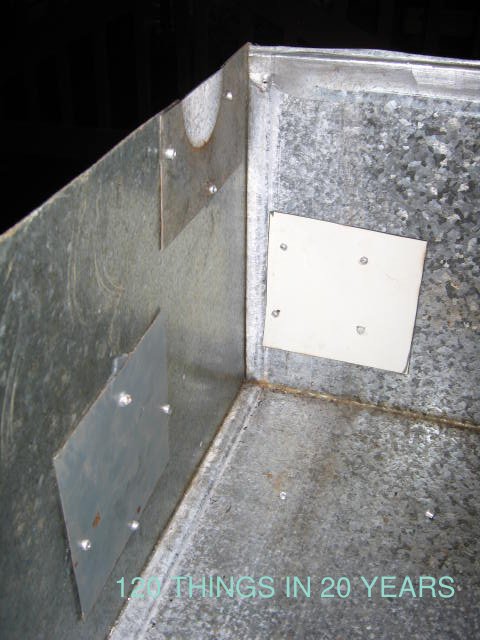
I cut the side of an old computer box into patches, and riveted them into place with some silicone between for water proofing. I probably didn't need the silicone because the rubber pond paint should seal any gaps, but I don't like leaks so much since my solar hot water project began.
I love rivets and you should as well. Hmmm rivets.
Really, rivets are amazing things because they pull the two surfaces together as they attach. Perfect for this kind of task due to the need for the silicone sandwiching action between the two surfaces.
Riveting!
I wonder if the old computer saw any of this in its future.
Sadly I couldn't find the bell siphon parts I was about to add to this grow bed. After searching for a while I sat down at my desk and realized I had recently used those very parts for the cheese press. So rather than making the bell siphon, I'm off to eat some haloumi.
Before I paint my new grow bed, it's going to need a few less holes. In a past life my grow bed was one half of an upright, square, modular rainwater tank. I'm told fishies dislike the zinc that leaches out of galvanized iron water tanks so they will be sealed in pond liner paint. Being a rainwater tank it has a few large holes cut into it to allow rainwater in.
I cut the side of an old computer box into patches, and riveted them into place with some silicone between for water proofing. I probably didn't need the silicone because the rubber pond paint should seal any gaps, but I don't like leaks so much since my solar hot water project began.
I love rivets and you should as well. Hmmm rivets.
Really, rivets are amazing things because they pull the two surfaces together as they attach. Perfect for this kind of task due to the need for the silicone sandwiching action between the two surfaces.
Riveting!
I wonder if the old computer saw any of this in its future.
Sadly I couldn't find the bell siphon parts I was about to add to this grow bed. After searching for a while I sat down at my desk and realized I had recently used those very parts for the cheese press. So rather than making the bell siphon, I'm off to eat some haloumi.
Aquaponics - Glass bell siphon
It's been said before, even by me, that a picture paints a thousand words. So imagine how many words a short video paints.
I think the key when building a siphon is to place a tap at some point on the hose coming from the pump to allow a small percent of the flow to be diverted. This allows you to increase or decrease the flow and makes making a siphon very easy. The most difficult thing to get right is to match the flow against the size of the standpipe (the standpipe is the white PVC pipe the water drains out of the bucket through.
in this video...
A bell siphon does that. It also generates a tide-like ebb and flow in the grow bed(s). This test siphon is in a small bucket, so the time it takes to flood and drain is only a few seconds. We could flood and drain as fast as this in aquaponics, but would then normally turn the pump off for up to an hour each cycle in order to let the plants breath for a bit. Alternatively we might use a smaller pump and run it all the time.
I made a glass bell siphon in an attempt to discover what actually goes on in one as it starts to siphon. It involved taking a glass jar, and turning it upside down.
I think the key when building a siphon is to place a tap at some point on the hose coming from the pump to allow a small percent of the flow to be diverted. This allows you to increase or decrease the flow and makes making a siphon very easy. The most difficult thing to get right is to match the flow against the size of the standpipe (the standpipe is the white PVC pipe the water drains out of the bucket through.
in this video...
- the siphon starts at around 00:20. Even though there is some flow before 20 seconds in, it doesn't really start properly until enough water is entering the standpipe to create the required suction)
- then stops at around 00:40. Note the rush of air in through the small hose within the jar and how quickly it stops the siphon.
- then the cycle repeats.
A bell siphon does that. It also generates a tide-like ebb and flow in the grow bed(s). This test siphon is in a small bucket, so the time it takes to flood and drain is only a few seconds. We could flood and drain as fast as this in aquaponics, but would then normally turn the pump off for up to an hour each cycle in order to let the plants breath for a bit. Alternatively we might use a smaller pump and run it all the time.
Aquaponics - Overflow pipes
One small but very important detail I left out of the SketchUp diagram in the previous post is overflow pipes. If something goes wrong with the system and the siphons fail because a potato or a snail has made a home in one, it is vital that the water has some way to get back into the sump. The pump in the sump will be damaged if it is run without water.
Overflow pipes are simply pipes that will drain the grow beds before they overflow onto the ground. The pipes are set slightly above where the siphon would normally trigger and run through the side of the grow bed and back to the sump. If for some reason either of the siphons should fail, the water will run back into the sump and keep the system running. It wont be ideal but the fish will be happy and the pump will be happy. The plants should be fine as long as the beds don't stay flooded for too long.
They should never be needed but for the sake of $5 worth of fittings its worth adding them.
For an additional few cents a very small hose can be connected from a hole in the bottom of each grow bed to the overflow pipes so that there is always a small constant stream of water draining from the grow beds to the sump. This is done in case the main pump fails. In the event of the main pump failing, the garden beds could be half full of water and the plants can suffer as a result. The slight leak allows the beds to drain albeit over a few hours.
Main pump fails -
grow beds slowly drain and will be fine for up to 3 days (plants and bacteria) depending on weather.
fish are fine because the powerhead keeps the oxygen levels up.
Power head fails -
doesn't bother the fish as the main pump is still doing it's thing.
doesn't bother the grow beds as they don't get any water from the power head.
Siphon fails -
water overflows through the overflow pipes back into the sump so sump pump is fine.
gardens are flooded but they can take that for a while depending on the plants (eg. lettuce can grow in permanently flooded beds)
Overflow pipes are simply pipes that will drain the grow beds before they overflow onto the ground. The pipes are set slightly above where the siphon would normally trigger and run through the side of the grow bed and back to the sump. If for some reason either of the siphons should fail, the water will run back into the sump and keep the system running. It wont be ideal but the fish will be happy and the pump will be happy. The plants should be fine as long as the beds don't stay flooded for too long.
They should never be needed but for the sake of $5 worth of fittings its worth adding them.
For an additional few cents a very small hose can be connected from a hole in the bottom of each grow bed to the overflow pipes so that there is always a small constant stream of water draining from the grow beds to the sump. This is done in case the main pump fails. In the event of the main pump failing, the garden beds could be half full of water and the plants can suffer as a result. The slight leak allows the beds to drain albeit over a few hours.
Main pump fails -
grow beds slowly drain and will be fine for up to 3 days (plants and bacteria) depending on weather.
fish are fine because the powerhead keeps the oxygen levels up.
Power head fails -
doesn't bother the fish as the main pump is still doing it's thing.
doesn't bother the grow beds as they don't get any water from the power head.
Siphon fails -
water overflows through the overflow pipes back into the sump so sump pump is fine.
gardens are flooded but they can take that for a while depending on the plants (eg. lettuce can grow in permanently flooded beds)
Within an aquaponics system its always good to have backups for whatever critical systems you have, especially when they can be done for a relatively small cost.
Aquaponics - Bell siphon
The bell siphon was a clever thing for someone to design, and as such you feel a bit of that "clever" rub off onto you when you make one. I made one, and feel a slight increase in my cleverness.
There isn't that much to a bell siphon, but what little there is tends to be very important.
A bell siphon consists of ...
- a standpipe (the bit that goes through the bottom of your grow bed)
- a bell (the bit that sits over the standpipe)
A bell siphon can also have...
- a siphon breaking air tube
- water inlet holes
- a media screen (cut off soft drink bottle with holes)
The bell sits over the standpipe.
The siphon breaking air tube is a tube that goes from the uppermost chamber formed by the bell, to a point around 1.5 cm above the bottom of the grow bed. If you dont have the tube, its possible for the siphon to continue draining the grow bed as the water is being pumped in. That is, when the siphon should have stopped and the bed should be filling again, it is possible that water will just keep flowing out at the same speed that its flowing in. By allowing a small stream of air into the top chamber you can break the siphons ability to continue suction when the water gets low enough to expose the pipe. When the bed is full and the siphon starts, this tube doesn't really do anything because its sucking water not air. But as soon as the bottom of this tube is exposed to air, it brings the siphon action to an abrupt halt allowing the cycle to start again.
A bell siphon also has some cutouts to allow the water to flow in unrestricted. These can be cut outs or a series of holes drilled near the base.I used cutouts.
Make the standpipe not too tall (so water doesnt get blocked by the bell sitting right on top of it) and also wide enough to allow enough water to drain through it. The standpipe needs to have a diameter large enough to allow the water to drain faster than the pump is pumping water in. A large diameter standpipe is important, but dont go too large. If the standpipe is too wide the water will be able to run down on only one side and never form the seal required to start the siphon. If this happens the water will just flow out at the same rate the pump is pumping it in. To get the siphon to start, reduce the size of the standpipe or increase the flow rate of the pump until it's flow fills the tube.
Some things that will cause your bell siphon to fail are...
- air bubbles in the hose running back to your fish tank. (keep it free of kinks and always sloping down - the return hose should drain until it is completely empty at the end of each cycle)
- too small a diameter of standpipe for the flow (or too much pump flow)
- too large a diameter of standpipe(or not enough pump flow)
- gravel getting into your siphon (make a media screen)
- water entering your standpipe too much from one side (cut your standpipe so that its level to help get a rush of water all at once when the water level gets high enough - this helps fill the tube and start the siphon)
- having too small a gap at the top between your standpipe and the bell (make your bell taller)
- restricting the flow within the bell because there is not enough gap for water to travel up the bell (make your bell wider)
Even though aquaponics is a fascinating subject, when you make a bell auto-siphon those around you will tire of your company quickly. Try to include other topics of conversation when meeting friends. Other people wont find your auto-siphon as interesting to watch as you will.
[link from the future on calibrating a new bell siphon]
There isn't that much to a bell siphon, but what little there is tends to be very important.
A bell siphon consists of ...
- a standpipe (the bit that goes through the bottom of your grow bed)
- a bell (the bit that sits over the standpipe)
A bell siphon can also have...
- a siphon breaking air tube
- water inlet holes
- a media screen (cut off soft drink bottle with holes)
The bell sits over the standpipe.
The siphon breaking air tube is a tube that goes from the uppermost chamber formed by the bell, to a point around 1.5 cm above the bottom of the grow bed. If you dont have the tube, its possible for the siphon to continue draining the grow bed as the water is being pumped in. That is, when the siphon should have stopped and the bed should be filling again, it is possible that water will just keep flowing out at the same speed that its flowing in. By allowing a small stream of air into the top chamber you can break the siphons ability to continue suction when the water gets low enough to expose the pipe. When the bed is full and the siphon starts, this tube doesn't really do anything because its sucking water not air. But as soon as the bottom of this tube is exposed to air, it brings the siphon action to an abrupt halt allowing the cycle to start again.
A bell siphon also has some cutouts to allow the water to flow in unrestricted. These can be cut outs or a series of holes drilled near the base.I used cutouts.
Make the standpipe not too tall (so water doesnt get blocked by the bell sitting right on top of it) and also wide enough to allow enough water to drain through it. The standpipe needs to have a diameter large enough to allow the water to drain faster than the pump is pumping water in. A large diameter standpipe is important, but dont go too large. If the standpipe is too wide the water will be able to run down on only one side and never form the seal required to start the siphon. If this happens the water will just flow out at the same rate the pump is pumping it in. To get the siphon to start, reduce the size of the standpipe or increase the flow rate of the pump until it's flow fills the tube.
Some things that will cause your bell siphon to fail are...
- air bubbles in the hose running back to your fish tank. (keep it free of kinks and always sloping down - the return hose should drain until it is completely empty at the end of each cycle)
- too small a diameter of standpipe for the flow (or too much pump flow)
- too large a diameter of standpipe(or not enough pump flow)
- gravel getting into your siphon (make a media screen)
- water entering your standpipe too much from one side (cut your standpipe so that its level to help get a rush of water all at once when the water level gets high enough - this helps fill the tube and start the siphon)
- having too small a gap at the top between your standpipe and the bell (make your bell taller)
- restricting the flow within the bell because there is not enough gap for water to travel up the bell (make your bell wider)
Even though aquaponics is a fascinating subject, when you make a bell auto-siphon those around you will tire of your company quickly. Try to include other topics of conversation when meeting friends. Other people wont find your auto-siphon as interesting to watch as you will.
[link from the future on calibrating a new bell siphon]
Aquaponics - Flood and drain
Plants seem to like it when their roots are not too wet and not too dry. Goldilocks would have us set the moisture level juuuust right, but in aquaponics, there is a better way. Flood and drain.
In our blue barrel system (pictured here at day one) we have half a barrel at ground level as a fish tank, and half raised above the fish tank as a grow bed (within the online forums you will see FT as fish tank and GB as grow or garden bed)
This allows us to pump water up to the grow bed and have it drain back down with gravity. But rather than have it running all the time the plants prefer to get some water, then some air, to their roots. One very simple way of doing this is to use an auto-siphon.
An auto-siphon allows us to fill the grow bed with nutrient rich water to a predetermined level, and then have the water dump back out into the fish tank bellow, exposing our plant's roots to the air. Plants love that kind of thing. And the fish love the circulating water. Keeping the water moving oxygenates it and running it through the grow beds filters it.
A bell auto-siphon would look something like this if someone were to make an animation of one working ...
- water is pumped in at the top from the fish tank (FT not shown)
- when the water level rises to the top of the standpipe (the standpipe is the innermost pipe) it starts to overflow.
- As the standpipe fills and the water flows down the tube and back into the fish tank, it forms a siphon.
- the small amount of air left at the top of the bell (the bell is the bit that surrounds the standpipe) is sucked down with the water and the grow bed quickly drains back into the fish tank.
- when the grow bed level gets to the bottom of the bell the siphon is broken and the draining action stops
- the water is always running in but the siphon is designed to allow water to flow out faster than it comes in
- the result of this is a flood and drain cycle that plants love.
Other beasties in the grow bed love this flood and drain as well but more on that later.
In our blue barrel system (pictured here at day one) we have half a barrel at ground level as a fish tank, and half raised above the fish tank as a grow bed (within the online forums you will see FT as fish tank and GB as grow or garden bed)
This allows us to pump water up to the grow bed and have it drain back down with gravity. But rather than have it running all the time the plants prefer to get some water, then some air, to their roots. One very simple way of doing this is to use an auto-siphon.
An auto-siphon allows us to fill the grow bed with nutrient rich water to a predetermined level, and then have the water dump back out into the fish tank bellow, exposing our plant's roots to the air. Plants love that kind of thing. And the fish love the circulating water. Keeping the water moving oxygenates it and running it through the grow beds filters it.
A bell auto-siphon would look something like this if someone were to make an animation of one working ...
- water is pumped in at the top from the fish tank (FT not shown)
- when the water level rises to the top of the standpipe (the standpipe is the innermost pipe) it starts to overflow.
- As the standpipe fills and the water flows down the tube and back into the fish tank, it forms a siphon.
- the small amount of air left at the top of the bell (the bell is the bit that surrounds the standpipe) is sucked down with the water and the grow bed quickly drains back into the fish tank.
- when the grow bed level gets to the bottom of the bell the siphon is broken and the draining action stops
- the water is always running in but the siphon is designed to allow water to flow out faster than it comes in
- the result of this is a flood and drain cycle that plants love.
Other beasties in the grow bed love this flood and drain as well but more on that later.
Subscribe to:
Posts (Atom)
Popular Posts
-
You see CHIFT PIST a lot in the aquaponics forums and it means "constant height in fish tank, pump in sump tank". And its a very g...
-
The bell siphon was a clever thing for someone to design, and as such you feel a bit of that "clever" rub off onto you when you m...
-
A "bell siphon" is a device that automates the flooding and draining of an aquaponics grow bed, even though the pump is adding wa...
-
Apparently, marron come in two varieties. Hairy and not so hairy. Cherax cainii (smooth) and Cherax tenuimanus, or Margret River marron (hai...
-
A while ago I tried to make a fish fed fish feeder design that would allow the fish to feed themselves. I think It's made. I say ...
-
Painting lures is easier if you don't know how. I don't, so I'm already well on my way. I started by owning a printer. That ...
-
If you pump air down into a submerged tube, when the bubbles rise to the surface, by virtue of the fact that they take up some space, they c...
-
The good thing about growing things like potatoes in aquaponics is they grow like crazy. The problem with growing things like potatoes in ...
-
Wire is one of the greats. It's power lies in its ability to be made shorter and apply great tension, with the application of many small...
-
With a little practice its possible to make a screw. If you bend your wire into an eyelet, its possible to make a screw in eyelet. The use...