Over the last few days, I've been reading a stack of stuff on radial flow and swirl filters.
Here's what I think I know so far.
As far as I can tell a radial flow filter moves the water in a very gentle manner, first down then up. The solids stay at the bottom. It often does this by having a container inside another container. One container acts like a bucket, and the other is mounted upside down from the lid. You add water and solid waste into the centre top, where it gently moves down to under the rim of the upside down container. The water then rises up to exit near the top outside rim, leaving the solids behind at the bottom. A tap is placed at the bottom so you can remove the solids.
I think I'm going with a swirl filter instead.
The swirl filter migrates solids towards the centre and the bottom, which should be the best position to remove them via a siphon. The path the solids take is a long one because the flow is circular due to the direction of flow on entry to the device. This allows more time for the solids to fall out of suspension (maybe).
So a swirl filter is a bucket with an inlet pipe mounted near the rim to introduce water and solid waste from the fish tank. The inlet tube is pointed in such a way as to make the water create a gentle whirlpool.
Normally, a tap is added to the bottom to remove the solids once collected.
As far as I can tell, a swirl filter changes the pressure of the water on the outside, making it higher than that of the centre due to it's rotational ... disposition.
This pressure (and depth) difference means that the top is no longer the top as far as the poop goes. The poop now thinks the top outside edge is the new top, and the bottom centre is the new bottom. So the poop moves to the new bottom which is right where I'l mount the bell siphon.
What all this means is that the poop is a little more committed to sinking than it's normal, only slightly sinking self.
It's also more likely to settle out near the centre of the bottom of the swirl filter.
Instead of using a tap mounted through the bottom of the swirl filter, I'll be adding an auto siphon in an attempt to automate the dumping of the solids into a worm farm.
Showing posts with label swirl filter. Show all posts
Showing posts with label swirl filter. Show all posts


Aquaponics - Self cleaning swirl filter revisited
One of the many people named Anonymous took the time to comment on my self cleaning swirl filter, so I thought I'd revisit the topic with some thoughts I've been having.
For the last few weeks I've been thinking of getting some more fish.
And I've also been thinking about developing the self cleaning swirl filter a little more.
My original design was to tap off a small amount of clean water for NFT tubes employing the self cleaning filter to keep the roots from collecting solids and blocking the NFT tubes. In the end I got around that by just taking my water from the sump, where there were no solids, but that required a better pump to get water to the top of the tubes. .
If this were ever to be implemented as a system to remove solids from a system rather than returning them to the grow beds it would need some adjustment.
It's easy to set up a container so that it is right at the point of tripping a siphon, but will never actually get there unless someone suddenly dumps water into it. With this in mind, one option I thought of when I was playing with this idea, was to use a deer scarer...
http://en.wikipedia.org/wiki/Shishi-odoshi
Set a dripping tap, so it slowly filled a deer scarer. The deer scarer should tip only once or twice a day, and should dump the same amount of water that the self cleaning swirl filter takes from the system each time it's triggered.
I'm going to build a deer scarer, and see how it works, then see if it really would take care of dosing the self cleaning filter with the correct amount of water to make it do it's thing.
You can see my previous work on my self cleaning swirl filter here.
For the last few weeks I've been thinking of getting some more fish.
And I've also been thinking about developing the self cleaning swirl filter a little more.
My original design was to tap off a small amount of clean water for NFT tubes employing the self cleaning filter to keep the roots from collecting solids and blocking the NFT tubes. In the end I got around that by just taking my water from the sump, where there were no solids, but that required a better pump to get water to the top of the tubes. .
If this were ever to be implemented as a system to remove solids from a system rather than returning them to the grow beds it would need some adjustment.
It's easy to set up a container so that it is right at the point of tripping a siphon, but will never actually get there unless someone suddenly dumps water into it. With this in mind, one option I thought of when I was playing with this idea, was to use a deer scarer...
http://en.wikipedia.org/wiki/Shishi-odoshi
Set a dripping tap, so it slowly filled a deer scarer. The deer scarer should tip only once or twice a day, and should dump the same amount of water that the self cleaning swirl filter takes from the system each time it's triggered.
I'm going to build a deer scarer, and see how it works, then see if it really would take care of dosing the self cleaning filter with the correct amount of water to make it do it's thing.
You can see my previous work on my self cleaning swirl filter here.
Aquaponics - Self cleaning swirl filter Mk 2 part 2
The new version of the self cleaning swirl filter actually works.
The water enter via the green garden hose almost at the bottom, sets up a whirl pool, and exits via four points
The first exit is a small hole in the standpipe (not shown in the video) The second is the black plastic leaf skimmer that we see taking out some floating duckweed, the third is the bell siphon (big white thing in the centre). All those three water exits go back to the grow beds and take solids with them.
The other exit is to the NFT tubes and is the clear plastic tube that we see first up. A few things look like they nearly get sucked ito it, but it actually does a pretty good job of only taking clear water. This tube is set just below the low tide that the siphon creates.
As far as I know this is an original idea, but I've been wrong before. Rather than my usual disclaimer, this time I offer nothing but this.
The water enter via the green garden hose almost at the bottom, sets up a whirl pool, and exits via four points
The first exit is a small hole in the standpipe (not shown in the video) The second is the black plastic leaf skimmer that we see taking out some floating duckweed, the third is the bell siphon (big white thing in the centre). All those three water exits go back to the grow beds and take solids with them.
The other exit is to the NFT tubes and is the clear plastic tube that we see first up. A few things look like they nearly get sucked ito it, but it actually does a pretty good job of only taking clear water. This tube is set just below the low tide that the siphon creates.
As far as I know this is an original idea, but I've been wrong before. Rather than my usual disclaimer, this time I offer nothing but this.
Aquaponics - Self cleaning swirl filter Mk 2
I think I have a better idea for a self cleaning swirl filter.
 Water enters a bucket part way up from the bottom. My picture show half way up, but I think it would be better where the "*" is around a third of the way up. The water enters via an elbow to set up a whirl pool.
Solids gravitate towards the centre, and sink to the bottom.
The first dump back to the grow beds is a hole in the stand pipe down the bottom, that creates a constant, gentle, downwards flow to further encourage solids to drop out of suspension.
The second dump device, is a bell siphon that periodically dumps water, creating a powerful suction, cleaning the filter of collected solids and returning them to the grow bed. This siphon is shortened by a breather pipe that means it only changes the height of water from between the "high tide" and the "low tide" marks rather than dumping all the water. If all the water is dumped, you loose the gentle entry of the water, and the swirl is broken down each time the device is empty.
A third dump intermittently exists at the top of the filter to act as a leaf skimmer. This would only flow at the top of each fill cycle, and would just be a trickle for a few seconds as the container is at its fullest, and would dump any floating particulates back to the grow bed.
Finally, water exits from the filter from a point just under the low tide mark. This would be the water that flows through the NFT tubes as it would be almost free of heavy solids, and would also not collect any floating solids.
Floating solids are sometimes sucked into the pump when fish disrupt them from the surface, when they get caught into a whirl pool and sucked down into the pump, or when the grow bed empties onto them, pushing them under water. Duckweed is at a very fine balance between floating and sinking when it's getting old, and can stay under water for a minute or so before slowly rising back to the surface. A fish swimming by can easily pull some under water where it might find it's way to the filter. It doesn't happen often, but I find 3 or four leaves a day go through the pump if I put a sieve under the grow bed outlet to check what the pump is lifting up.
There you have it, a self cleaning swirl filter.
Perhaps.
I'll make one to check.

Solids gravitate towards the centre, and sink to the bottom.
The first dump back to the grow beds is a hole in the stand pipe down the bottom, that creates a constant, gentle, downwards flow to further encourage solids to drop out of suspension.
The second dump device, is a bell siphon that periodically dumps water, creating a powerful suction, cleaning the filter of collected solids and returning them to the grow bed. This siphon is shortened by a breather pipe that means it only changes the height of water from between the "high tide" and the "low tide" marks rather than dumping all the water. If all the water is dumped, you loose the gentle entry of the water, and the swirl is broken down each time the device is empty.
A third dump intermittently exists at the top of the filter to act as a leaf skimmer. This would only flow at the top of each fill cycle, and would just be a trickle for a few seconds as the container is at its fullest, and would dump any floating particulates back to the grow bed.
Finally, water exits from the filter from a point just under the low tide mark. This would be the water that flows through the NFT tubes as it would be almost free of heavy solids, and would also not collect any floating solids.
Floating solids are sometimes sucked into the pump when fish disrupt them from the surface, when they get caught into a whirl pool and sucked down into the pump, or when the grow bed empties onto them, pushing them under water. Duckweed is at a very fine balance between floating and sinking when it's getting old, and can stay under water for a minute or so before slowly rising back to the surface. A fish swimming by can easily pull some under water where it might find it's way to the filter. It doesn't happen often, but I find 3 or four leaves a day go through the pump if I put a sieve under the grow bed outlet to check what the pump is lifting up.
There you have it, a self cleaning swirl filter.
Perhaps.
I'll make one to check.
Aquaponics - Self cleaning swirl filter
Some stuff is better than other stuff.
This test is more like other stuff.
But it does illustrate the kind of thing a swirl filter might do if it were designed a bit better.
The first scene shows water entering through the thick black pipe on the bottom right of screen. The water exits the pipe via an elbow that directs water to the right so that a gentle whirl pool is set up.
You can see that the solids (these are real fish solids from a sieve I put under the inlet to the grow bed) do indeed collect in the centre and once they are there, they quickly sink to the bottom. Much of the stuff that looks like its going down into the standpipe (black centre) is actually an optical illusion. 95% of that is too low to be sucked in, but just appears distorted by the lensing that occurs with the water shape at the top of the tube. In the final product, a bell would sit over the top, so that wouldn't be happening, but that's the exit pipe back to the grow bed, so that's where we want the solids to go anyway.
After the bell siphon magically appears (I must learn how to do better scene transitions), we see the siphon kick in and most of the solids get sucked in, to return to the grow bed.
I add the same solids back again after collecting them with a spoon from a sieve.
The clear plastic tube on the left is where clean water would be drawn off to feed the NFT tubes. Water only exits via that tube for a few seconds at the top of each cycle. The length of time that water flows can be varied by the flow rate allowed through the tube. If you have a flow rate that takes a lot of water, it takes longer for the siphon to kick in. The exit flow could also be adjusted by simply moving the tube down a little from the rim. I placed it high because my little bucket was never going to be deep enough, so I was trying to get the most out of what little depth I had.
All in all, I guess this test was a success, even though it didn't work as well as I would have liked.
I Think it works well enough for me to have a go at making a bigger, better one.
This test is more like other stuff.
But it does illustrate the kind of thing a swirl filter might do if it were designed a bit better.
The first scene shows water entering through the thick black pipe on the bottom right of screen. The water exits the pipe via an elbow that directs water to the right so that a gentle whirl pool is set up.
You can see that the solids (these are real fish solids from a sieve I put under the inlet to the grow bed) do indeed collect in the centre and once they are there, they quickly sink to the bottom. Much of the stuff that looks like its going down into the standpipe (black centre) is actually an optical illusion. 95% of that is too low to be sucked in, but just appears distorted by the lensing that occurs with the water shape at the top of the tube. In the final product, a bell would sit over the top, so that wouldn't be happening, but that's the exit pipe back to the grow bed, so that's where we want the solids to go anyway.
After the bell siphon magically appears (I must learn how to do better scene transitions), we see the siphon kick in and most of the solids get sucked in, to return to the grow bed.
I add the same solids back again after collecting them with a spoon from a sieve.
The clear plastic tube on the left is where clean water would be drawn off to feed the NFT tubes. Water only exits via that tube for a few seconds at the top of each cycle. The length of time that water flows can be varied by the flow rate allowed through the tube. If you have a flow rate that takes a lot of water, it takes longer for the siphon to kick in. The exit flow could also be adjusted by simply moving the tube down a little from the rim. I placed it high because my little bucket was never going to be deep enough, so I was trying to get the most out of what little depth I had.
All in all, I guess this test was a success, even though it didn't work as well as I would have liked.
I Think it works well enough for me to have a go at making a bigger, better one.
Aquaponics - Swirl filter variation
I had an idea, but now I'm not sure it was mine after all. But here it is anyway.
I need to get solids out of the water for the NFT, but I don't want to remove the solids from the entire system. It's the solids that make everything work.
I thought I'd give this a try.
I took a peanut butter bucket. (We eat a lot of peanut butter)
And drilled a hole in it in the bottom.
 Then drilled another hole near the lip.
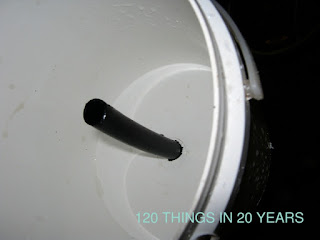 I added a 12mm poly pipe length as a standpipe.
 I also added an exit pipe (clear plastic top right), and an input pipe from the pump (19mm black poly pipe with an elbow)
The plan is to add water so that it swirls around.
The water on the inside moves slowly and the solids settle in the middle.
Actually I think there is something else going on here, but I'm not sure what it is.
If you put a helium balloon in a car, and put on the brakes, instead of the balloon moving forward like everything else, it rushes to the back of the car. The opposite also applies to acceleration and cornering. As far as I can tell, this happens because, under brakes, the pressure moves to the front. High pressure is like the pressure at ground level, and helium balloons hate being at ground level, so try to escape in the only direction they know how.
Up.
But it's not really up, its from high pressure to low pressure. Or in the case of the car, from the front (where all the air in the car is glugging toward) to the back.
Ask a kid with a balloon to try it.
I think something to do with something like that may, or may not, be happening here.
I'll try to find out.
 I put the bell from the grow bed's bell siphon over my stand pipe, and the end result looks like this.
I have both tubes dumping back to the grow bed because this is just a test, but normally only one would go back. The other (top left of the bucket) would be feeding the NFT tubes that you can see under the device in the background.
I'll take some video and post it up tomorrow, and hopefully capture the thing working.
I'm not sure that it will work all that well, because I think it's too small. I think it needs to be wider, to allow the centre to be very slow moving, and deeper, to allow more time for the particles to settle out.

I need to get solids out of the water for the NFT, but I don't want to remove the solids from the entire system. It's the solids that make everything work.
I thought I'd give this a try.
I took a peanut butter bucket. (We eat a lot of peanut butter)
And drilled a hole in it in the bottom.


The plan is to add water so that it swirls around.
The water on the inside moves slowly and the solids settle in the middle.
Actually I think there is something else going on here, but I'm not sure what it is.
If you put a helium balloon in a car, and put on the brakes, instead of the balloon moving forward like everything else, it rushes to the back of the car. The opposite also applies to acceleration and cornering. As far as I can tell, this happens because, under brakes, the pressure moves to the front. High pressure is like the pressure at ground level, and helium balloons hate being at ground level, so try to escape in the only direction they know how.
Up.
But it's not really up, its from high pressure to low pressure. Or in the case of the car, from the front (where all the air in the car is glugging toward) to the back.
Ask a kid with a balloon to try it.
I think something to do with something like that may, or may not, be happening here.
I'll try to find out.

I have both tubes dumping back to the grow bed because this is just a test, but normally only one would go back. The other (top left of the bucket) would be feeding the NFT tubes that you can see under the device in the background.
I'll take some video and post it up tomorrow, and hopefully capture the thing working.
I'm not sure that it will work all that well, because I think it's too small. I think it needs to be wider, to allow the centre to be very slow moving, and deeper, to allow more time for the particles to settle out.
Aquaponics - Fish waste solids masticator
I guess it's just plain laziness, but I'd rather not chew my fish's solid waste.
Luckily shell grit is willing to do it for me.
This is as yet untested, and in my experiments so far, there are some potential stumbling blocks to overcome, but this is what I'm working on...
We need shell grit in the system to buffer pH, so I figured I'd put it to use to break down solid fish waste, before it enters the grow bed. This is probably unnecessary, but I'm hoping to distribute the waste more evenly throughout the grow bed. I'm also hoping to grow some strawberries in PVC pipes at some stage, so it will be necessary to have very clear water running through them so they don't block, as the roots will almost fill the pipes.
 This represents a possible solution to keeping the water moving freely throughout my system, if I end up needing it.
The general idea is that fish solids enter with the water, and because of the direction of the inlet flow, they swirl around. The water overflows leaving the solids behind. In aquaculture, and sometimes in very densely populated aquaponics systems, this is employed with a tap at the bottom to allow removal of the solids from time to time.. It's called a swirl filter or solids filter. All I'm thinking about doing is adding shell grit to one, and making the grit and the solids tumble around until the solids get small enough that they rise up and overflow in the grow bed with the water. I don't want to lose my solid waste because me plants want all the nutrition that's in it. The general idea is that it should be a prefilter, and double as a way to add calcium carbonate.
In my larger system, I think I will incorporate a solids remover in case something goes wrong and I need to instantly lessen the nutrient load. I wont need to empty it in normal use, but I will have the option in an emergency.
Luckily shell grit is willing to do it for me.
This is as yet untested, and in my experiments so far, there are some potential stumbling blocks to overcome, but this is what I'm working on...
We need shell grit in the system to buffer pH, so I figured I'd put it to use to break down solid fish waste, before it enters the grow bed. This is probably unnecessary, but I'm hoping to distribute the waste more evenly throughout the grow bed. I'm also hoping to grow some strawberries in PVC pipes at some stage, so it will be necessary to have very clear water running through them so they don't block, as the roots will almost fill the pipes.

The general idea is that fish solids enter with the water, and because of the direction of the inlet flow, they swirl around. The water overflows leaving the solids behind. In aquaculture, and sometimes in very densely populated aquaponics systems, this is employed with a tap at the bottom to allow removal of the solids from time to time.. It's called a swirl filter or solids filter. All I'm thinking about doing is adding shell grit to one, and making the grit and the solids tumble around until the solids get small enough that they rise up and overflow in the grow bed with the water. I don't want to lose my solid waste because me plants want all the nutrition that's in it. The general idea is that it should be a prefilter, and double as a way to add calcium carbonate.
In my larger system, I think I will incorporate a solids remover in case something goes wrong and I need to instantly lessen the nutrient load. I wont need to empty it in normal use, but I will have the option in an emergency.
Subscribe to:
Posts (Atom)
Popular Posts
-
 You see CHIFT PIST a lot in the aquaponics forums and it means "constant height in fish tank, pump in sump tank". And its a very g...
 -
 The bell siphon was a clever thing for someone to design, and as such you feel a bit of that "clever" rub off onto you when you m...
 -
 A "bell siphon" is a device that automates the flooding and draining of an aquaponics grow bed, even though the pump is adding wa...
 -
 Apparently, marron come in two varieties. Hairy and not so hairy. Cherax cainii (smooth) and Cherax tenuimanus, or Margret River marron (hai...
 -
 A while ago I tried to make a fish fed fish feeder design that would allow the fish to feed themselves. I think It's made. I say ...
 -
 Painting lures is easier if you don't know how. I don't, so I'm already well on my way. I started by owning a printer. That ...
 -
 If you pump air down into a submerged tube, when the bubbles rise to the surface, by virtue of the fact that they take up some space, they c...
 -
 The good thing about growing things like potatoes in aquaponics is they grow like crazy. The problem with growing things like potatoes in ...
 -
 Wire is one of the greats. It's power lies in its ability to be made shorter and apply great tension, with the application of many small...
 -
 With a little practice its possible to make a screw. If you bend your wire into an eyelet, its possible to make a screw in eyelet. The use...